
Why impregnate a concrete floor?
A bare concrete floor dusts: under wheels and shoes, particles of hardened cement paste constantly break away from the weak surface layer. The pores absorb oil, water and dirt, so the floor darkens in patches and is hard to clean. Impregnations solve these problems without a separate coating: they penetrate the surface layer and harden and densify it, or form a thin protective film. This is the most economical way to put in order a new floor after trowelling or grinding, or an old warehouse or car park floor.
The European standard EN 1504-2 distinguishes three methods of surface protection for concrete: hydrophobic impregnation, impregnation and coating. Hardening impregnations and floor sealers fall under impregnations and thin coatings; water repellents only repel water and do not stop dusting.
Types of material
Silicate hardeners
Aqueous solutions of lithium, sodium or potassium silicates, as well as metal fluorosilicates. As they penetrate the concrete, they react with the cement hydration products, and the resulting compounds fill the pores of the surface layer. The surface becomes harder and denser, dusts less and absorbs less dirt; over time and with polishing, it acquires a sheen. According to manufacturers, lithium products are less prone than sodium and potassium ones to forming white efflorescence when too much material is applied. Silicates are used on new trowelled and ground floors and on sound old concrete.
Polymer sealers
Solutions or dispersions of acrylic, epoxy and polyurethane resins. They partly penetrate the concrete and form a thin film on the surface: they bind dust, reduce the absorption of oil and water and make cleaning easier. Epoxy and polyurethane sealers give a stronger, more chemically resistant film, while acrylic ones are easier to apply and renew. The film wears over time, so it is renewed.
Curing compounds for fresh concrete
Immediately after trowelling, the concrete needs to retain moisture for hydration. Curing compounds form a temporary film on the surface that slows evaporation; some of them also seal and dustproof the surface at the same time. The compatibility of such a compound with a coating to be applied later is checked in advance against the data sheet: some films will have to be removed before painting.
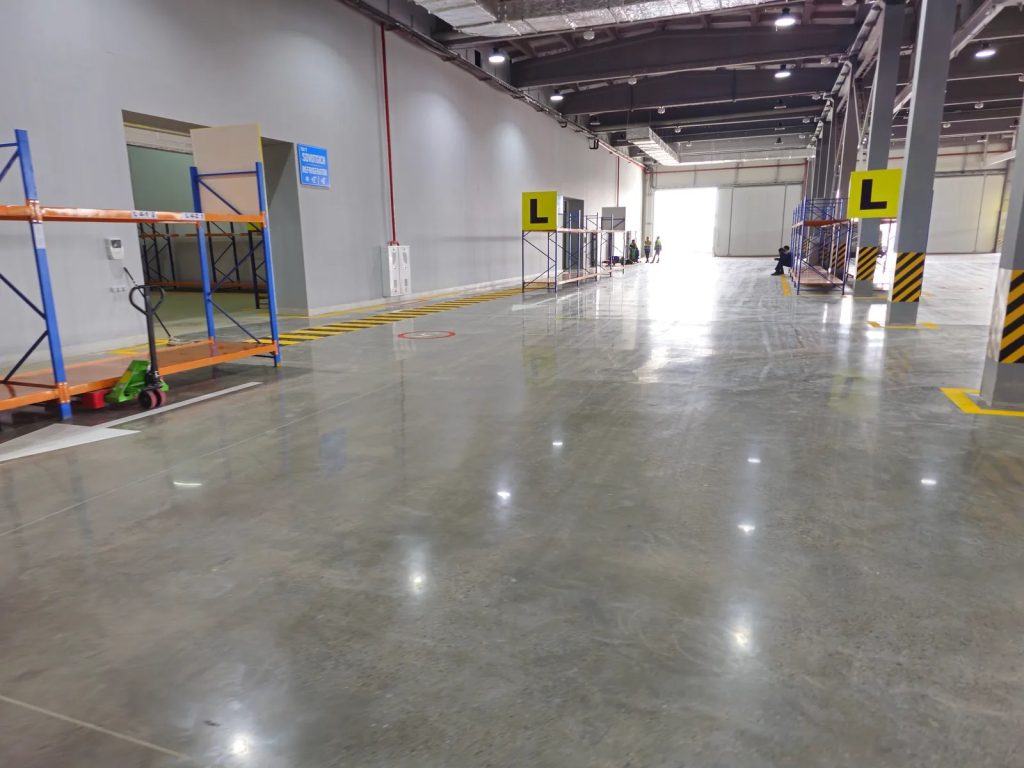
The floor after impregnation: photos from a warehouse
This is what a warehouse concrete floor treated with an impregnation looks like: racking areas, aisles and floor markings.


What impregnations can and cannot do
- They can harden and dustproof sound concrete, reduce the absorption of liquids, make cleaning easier and improve appearance.
- They cannot restore weak, frost-damaged or deteriorated concrete, fill potholes and cracks, or level a floor.
- They do not provide chemical protection comparable to a polymer coating: acids, sugars and aggressive cleaning agents call for epoxy or polyurethane cement systems.
- They do not bridge cracks or stop moisture rising from below.
Where the floor is subject to strict requirements on dust release, the Uzbek code ShNK 2.03.13-24 “Floors” sets classes of “low-dust” finishes with an abrasion loss of no more than 0.4 g/cm² and “dust-free” finishes with no more than 0.2 g/cm². Whether impregnated concrete will reach the required class depends on the original concrete; where the requirements are strict, a seamless polymer coating is more reliable.
How to choose
New or old floor
For a new floor after trowelling, choose a curing compound with a dustproofing effect or a silicate hardener, applied within the times specified in the data sheet. For an old floor, a silicate hardener or a polymer sealer after mechanical cleaning.
Loads and surface type
For intensive traffic and ground concrete floors, silicate hardeners, which do not form a film that can wear away, are usually chosen. If colour, gloss or stain protection is needed, polymer sealers are used.
Subsequent work
If a resin coating is planned over the floor later, the impregnation is chosen so that it does not interfere with adhesion, or its removal is provided for during preparation — as instructed in the data sheet.
Application conditions
The moisture content and age of the concrete, the temperature, ventilation in the room and the acceptable odour determine the choice between water-based and solvent-based products.
Application procedure
- The concrete is mechanically cleaned of dirt, oil, old films and laitance, and then dust is removed.
- The impregnation is applied evenly with a low-pressure sprayer, a roller or a microfibre pad, without puddles, at the coverage rate given in the data sheet.
- Silicate hardeners are worked over the surface for the time specified in the data sheet and are not allowed to dry in puddles; the excess is removed.
- Polymer sealers are applied in thin coats at the intervals given in the data sheet, in two coats where necessary.
- Until the floor has developed its properties, it is protected from water, dirt and traffic.
Floor maintenance after impregnation
- Cleaning begins after the times given in the data sheet; neutral cleaners are used for daily washing so as not to damage the sealer film.
- Spills of oil, acids and sugary liquids are cleaned up immediately: an impregnation slows down absorption but does not make the concrete chemically resistant.
- Worn areas of polymer sealer are renewed without waiting for the concrete to start dusting again.
- Ground concrete floors treated with a silicate hardener are polished periodically — this maintains the sheen and density of the surface.
Common mistakes
- Impregnating dusty or oil-contaminated concrete — the material does not penetrate and stains remain.
- Excess silicate left to dry on the surface — a white bloom and slippery patches.
- Expecting an impregnation to save weak or deteriorated concrete.
- An impregnation or curing film incompatible with a subsequent resin coating — the coating delaminates.
- A polymer sealer in an area of intensive forklift traffic — rapid wear of the film.
See also: resin flooring — overview, dry-shake hardeners, epoxy floors.
Materials in the catalogue
- Sikafloor CureHard LI — Sika — lithium silicate hardener, densifier and dustproofer for new and old concrete.
- Sikafloor ProSeal W — Sika — water-based acrylic curing, dustproofing and sealing compound for concrete floors.
- Jotafloor Sealer — Jotun — clear two-pack epoxy concrete sealer, dust binder and primer for Jotafloor systems.
- Jotafloor Sealer WB — Jotun — one-pack waterborne acrylic concrete sealer for light-duty pedestrian floors.
- Fosroc Nitoflor Lithurin — Fosroc — fluorosilicate hardening and dustproofing treatment for new and old concrete floors.
- Mapecrete LI Hardener — Mapei — lithium silicate densifier for new and existing concrete floors, including dry-shake toppings.
This list is not exhaustive. The final choice is made on the basis of the manufacturer’s documents and the project requirements.
Frequently asked questions
What makes a lithium hardener better than a sodium one?
Manufacturers of lithium products point to a lower tendency to efflorescence when too much material is applied and to easier application. The final choice is made on the basis of the data sheet and a trial area on your concrete.
How does a sealer differ from a resin coating?
A sealer is a thin layer that mainly penetrates the concrete and closes its pores; it does not level the floor or carry the load itself. A resin coating is a separate layer, fractions of a millimetre or several millimetres thick, which protects the concrete against abrasion and chemicals and changes its appearance.
Does a floor with a dry-shake hardener need an impregnation?
It is not mandatory, but it is useful: a silicate hardener or a sealer further reduces dusting and oil absorption. The product is chosen to be compatible with the curing compound applied after trowelling — based on the data sheets of both materials.
How long does the effect of an impregnation last?
Silicate hardeners work inside the concrete and do not form a film that wears away; polymer sealers wear over time and need renewal. The duration depends on the load and the cleaning.
Can a floor be impregnated in an operating workshop?
Yes, area by area: water-based products have almost no odour, and the floor is returned to service after the drying times given in the data sheet.
We will select an impregnation or sealer for your floor and calculate the consumption — call us or message us on WhatsApp/Telegram: +998 94 094 52 27.