
How a hydrocarbon fire differs from an ordinary fire
Codes for housing, offices and most factory buildings assume a “standard” fire in which timber, paper, textiles and plastics burn. In such a fire the temperature rises gradually. At oil refineries, gas fields, chemical plants and power facilities the scenario is different: when petroleum products spill and ignite, the temperature reaches a very high level within the first few minutes, and the heat flux to the structure is considerably higher.
A separate and even more severe case is the jet fire. It occurs when a flammable gas or liquid under pressure escapes from a damaged pipe or process vessel and burns as a jet flame. Such a jet not only heats the structure but also mechanically “blasts away” a weak coating. That is why materials for the oil and gas industry are tested to separate methods and backed by separate certificates.
Shop application at the steel fabrication plant
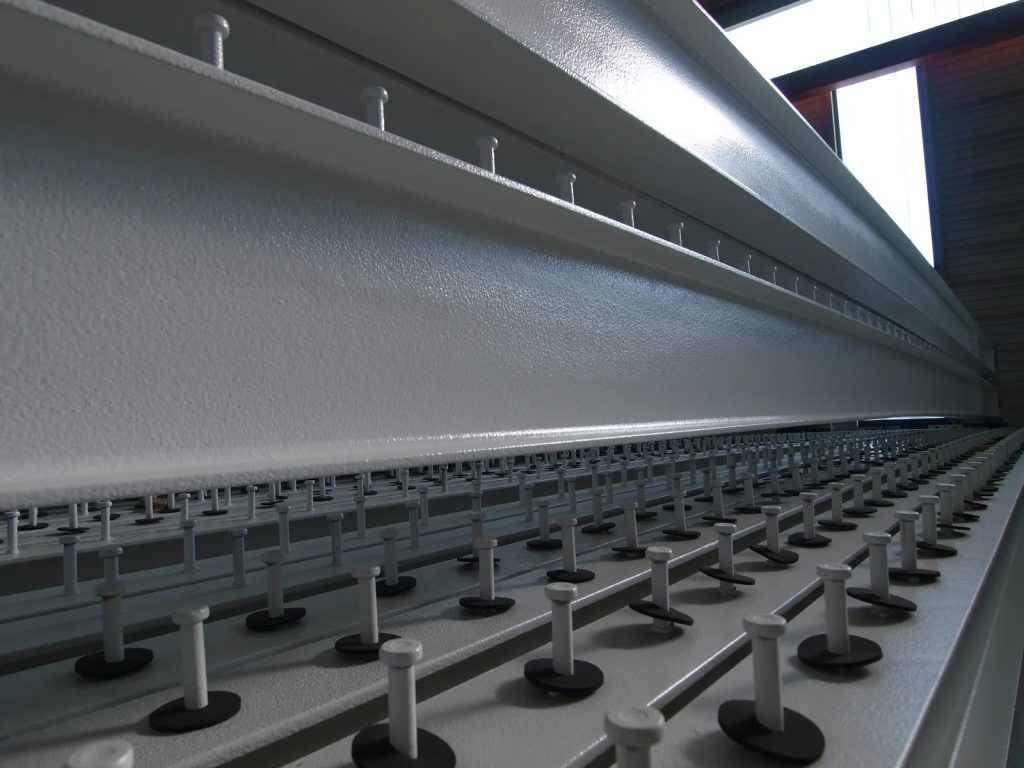
The main difference between epoxy fire protection and conventional fire protection is that it can be applied at the steel fabrication plant — in the shop, before erection. The photos show application and finished members in the shop.


Test methods found in project documentation
- UL 1709 — the US standard for fire resistance testing of structures under rapid-rise hydrocarbon fire conditions. It is the standard most often cited in the specifications of international oil and gas companies.
- Hydrocarbon curve to European standards (the EN 1363 series and related standards) — the equivalent time–temperature regime within the European testing system.
- ISO 22899-1 — a test method for the resistance of passive fire protection to jet fire.
- ISO 20088 series — resistance to cryogenic spills, relevant to LNG facilities.
- UL 2431 and NORSOK M-501 — tests of coating durability under atmospheric exposure; the latter is widely used for offshore installations.
The design or the client’s technical specification usually states explicitly which test method the material must comply with. If the specification says “jet fire”, a coating tested only to the hydrocarbon curve is not acceptable.
Materials used
Epoxy intumescent coatings
These are two- or multi-component systems with 100% volume solids, i.e. practically solvent-free. They intumesce when heated but, unlike thin-film paints, form a dense, strong char that can withstand the impact of a jet. Many systems are reinforced with mesh or glass cloth in areas where the test results require it; some products have approved unreinforced solutions for limited fire ratings.
An important advantage of epoxy systems is that they combine fire protection and corrosion protection in a single package. They resist weathering, chemicals and mechanical damage, and are often applied in the fabrication shop or at the module yard, which reduces the amount of work on site.
Cementitious coatings
Dense cementitious and cement-vermiculite products are a proven alternative for columns, vessel supports and pipe racks. They are heavier than epoxies but resist impact and hose streams, and some grades also protect against cryogenic spills. For details, see the “Fire protection plasters” page.
How to choose a system
- Fire scenario and duration. Hydrocarbon pool fire, jet fire or a combination of the two; the required duration is taken from the design and the risk analysis.
- What is being protected. Pipe rack columns and beams, vessel supports, vessel skirts, vessels, walls and partitions, cable routes. The manufacturer provides separate thickness tables for each type of element.
- Section massivity. As with conventional fire protection, the ratio of heated perimeter to cross-sectional area (Hp/A) plays a decisive role.
- Critical temperature. For oil and gas facilities it is often set by the client in its own standards — and it has a direct effect on thickness.
- Service conditions. Marine climate, temperature cycling, surface operating temperature, contact with process media.
- Corrosion protection system. The primer and, where required, the topcoat — only from the list tested together with the fire protection.
- Place of application. Fabrication shop, module yard or site — this determines the choice of equipment and the curing times.
Common mistakes
- Using a thin-film paint intended for “ordinary” buildings on an open-air plant handling petroleum products.
- Accepting a certificate covering only the hydrocarbon curve where “jet fire” is specified.
- Omitting reinforcement where the system calls for it.
- Poor surface preparation: epoxy fire protection requires the same standard of preparation as high-performance corrosion protection systems.
- Leaving terminations and interfaces unsealed — moisture gets under the coating through them.
- Repairing damage with “whatever is to hand” instead of a material from the same system.
Materials from leading manufacturers
- Chartek 1709 — International (AkzoNobel) — boron-free epoxy system for hydrocarbon and jet fires; fire and corrosion protection in a single layer.
- Chartek 7 — International (AkzoNobel) — epoxy coating for prolonged pool fires and jet fires.
- Thermo-Lag 3000-P — Carboline — flexible epoxy coating for steel, vessels and cable routes at petrochemical facilities.
- Pyroclad X1 — Carboline — jet-fire-certified epoxy coating for onshore and offshore facilities.
- FIRETEX M90/03 — Sherwin-Williams — epoxy system for hydrocarbon fires, tested for cryogenic spills.
- PPG PITT-CHAR NX — PPG — flexible epoxy system for protection against pool fire, jet fire and explosion.
- Pyrocrete 241 — Carboline — cementitious fire protection with hydrocarbon and jet fire ratings.
- Promat FENDOLITE MII — Promat — spray-applied cement-vermiculite coating for steel, spheres, tanks and concrete.
- Jotun Jotachar 1709 — Jotun — mesh-free epoxy intumescent coating for hydrocarbon and jet fires.
- Jotun Jotachar JF750 and JF750 XT — Jotun — mesh-free epoxy systems for pool and jet fires; XT is for extremely cold climates.
- Jotun Jotachar 1709 XT — Jotun — epoxy intumescent protecting steel from hydrocarbon pool fires, mesh-free up to 60 minutes.
- PPG PITT-CHAR XP — PPG — flexible epoxy intumescent coating for hydrocarbon pool and jet fires and cryogenic spills.
- Chartek 2218 — International (AkzoNobel) — boron-free epoxy intumescent for hydrocarbon pool fire, jet fire and cryogenic spill protection.
- Chartek 8E — International (AkzoNobel) — boron-free epoxy intumescent for hydrocarbon pool and jet fires on oil and gas facilities.
- Chartek 7E — International (AkzoNobel) — self-reinforced epoxy intumescent for pool and jet fires up to 2 hours.
- Chartek ONE — International (AkzoNobel) — boron-free, mesh-free epoxy intumescent, up to 3 hours hydrocarbon pool fire.
- Chartek 1620CSP — International (AkzoNobel) — epoxy intumescent for cryogenic spill, hydrocarbon pool and jet fire protection.
- Chartek 2218E — International (AkzoNobel) — boron-free epoxy intumescent for hydrocarbon pool and jet fires, applicable from −10 °C.
- Chartek 1960CSP — International (AkzoNobel) — epoxy intumescent for long cryogenic spills, hydrocarbon pool and jet fires.
Frequently asked questions
Can epoxy fire protection be used in an ordinary building?
Yes, there are epoxy systems for cellulosic fires too. They are chosen where high mechanical and weather resistance or shop application is required. For a typical building, however, they usually cost more than a thin-film paint.
Is a topcoat needed over epoxy fire protection?
It depends on the system and the environment. Some products have been tested for weathering resistance without a topcoat; others need one for UV protection or because the client requires it. The answer is given in the technical data sheet and the system specification.
Which matters more — UL 1709 or ISO 22899?
They are different tests: the first simulates a pool fire, the second — jet impingement. If the risk analysis includes both scenarios, the material must be approved for both.
Why are epoxy systems applied in the fabrication shop?
In the shop it is easier to control temperature, surface preparation and thickness, and the members arrive on site already protected. All that remains on site is to make good the joints and repair any damage.