
What is chemical protection?
Chemical protection is the part of corrosion protection that deals with equipment working in contact with aggressive media: acids, alkalis, salt solutions, oxidising agents (hypochlorite, chlorine), solvents and hot acidic condensates. This covers tanks and measuring tanks for chemicals, reactors and receivers, absorbers and scrubbers, ducts and chimneys downstream of flue gas desulphurisation, pickling and electroplating tanks, thickeners and slurry tanks, sumps, trenches and trays of secondary containment, pipelines, and road and rail tankers.
The requirements here are stricter than for atmospheric systems. A lining is constantly wetted or exposed to the vapours of the medium, operates at elevated temperature, under temperature fluctuations and often under vacuum, and the medium penetrates the material by diffusion. That is why the choice is not “a paint for the corrosivity category” but a material whose resistance to the specific product, concentration and temperature has been confirmed by the manufacturer, together with an application method that produces a continuous, pore-free coating.
Selecting chemical protection starts with a questionnaire. Resistance depends on the specific substances and their concentration, temperature and thermal shock, mechanical loads and cleaning, so it cannot be chosen from a general table. Fill in the questionnaire online — an engineer will select the type of protection, the material system and thicknesses.
Main material families
Vinyl ester coatings and linings
Vinyl ester resins cure with an organic peroxide by a free-radical mechanism. Bisphenol vinyl esters resist most acids, salt solutions and oxidising agents; novolac vinyl esters are more densely cross-linked and cope better with solvents and elevated temperatures. Glass or other inert flakes lie in layers within the film and lengthen the diffusion path, which is why flake-filled vinyl esters are applied in thick films — hundreds of micrometres and up to 1–1.5 mm — in one to three passes. On concrete and in particularly severe conditions, systems reinforced with glass mat or glass cloth are used.
Their characteristics: short pot life, shrinkage on curing, strict requirements for substrate temperature and humidity, and a limited overcoating interval. If the accelerator is supplied separately, it must never be mixed directly with the peroxide catalyst — they are added to the base one at a time in the order specified by the manufacturer.
Novolac epoxy and epoxy phenolic linings
Two-component epoxies based on novolac or phenolic resins are a common solution for tanks holding petroleum products, solvents, alkalis and hot water. They are used when the medium and temperature fall within the manufacturer’s resistance list and a vinyl ester or rubber lining would be excessive. These materials are described in the “Coatings for tanks and pipelines” section.
Rubber lining
A lining made of sheet rubber bonded to steel or concrete with a system of primers and adhesives. Soft linings — bromobutyl and chlorobutyl (BIIR, CIIR), chloroprene (CR), natural rubber (NR), EPDM, chlorosulphonated polyethylene with PVC (CSM/PVC) — are elastic and withstand impact, abrasion and thermal movement. Semi-hard and hard linings (ebonite) are stiffer and less elastic but, as a rule, more resistant to a number of media and to heat; they are more sensitive than soft linings to impact and sudden temperature changes.
By technology, a distinction is made between linings that are autoclave-vulcanised in the factory; vulcanised on site with steam, hot water or hot air; self-vulcanising at ambient temperature or under the action of the process medium; pre-vulcanised two-layer sheets that can be loaded immediately after laying; and chemically cured linings. Rubber lining is particularly strong where an aggressive medium is combined with abrasion: slurries, sludges, suspensions.
Other systems
For certain duties, thermoplastic and fluoropolymer linings are also used, as is acid-resistant tile and brick masonry laid in chemical-resistant mortars. There are no cards for thermoplastic and fluoropolymer linings in this section yet — they are selected on a project basis. Mortars for acid-resistant masonry — Asplit VEC and Asplit VEQ — are included in the list below.
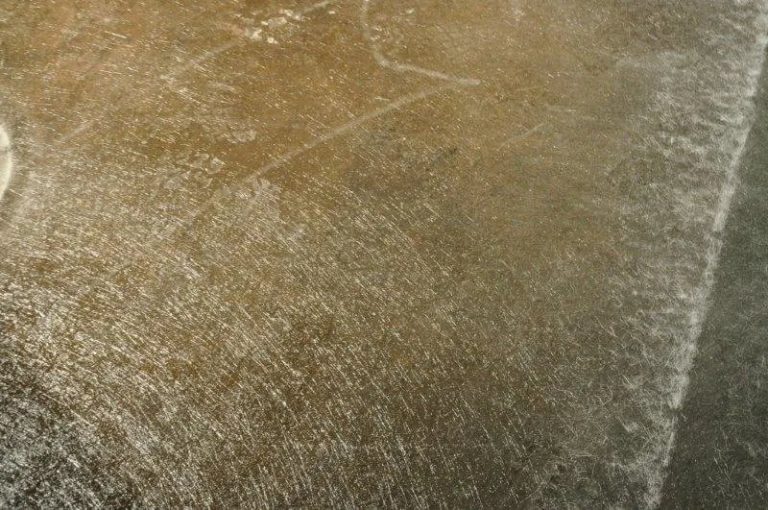
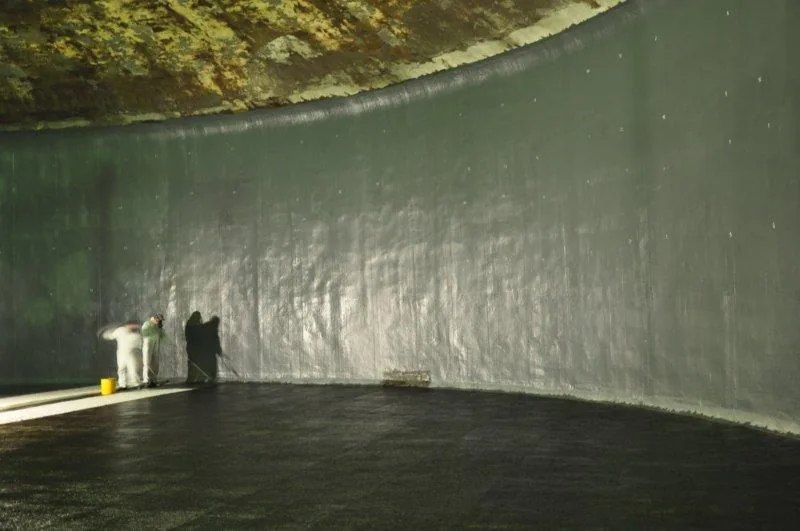
Laminated vinyl ester system: how it is applied
For extremely aggressive environments a laminated system is used: vinyl ester resin is reinforced with glass mat right on site. The photos show such a chemical protection system being applied.


How to choose a chemical protection system
Medium and concentration
The first step is the exact composition of the medium: substance, concentration, impurities, solvents, oxidising agents, solid particles. If the vessel is used for different products or is washed with alkali and acid, the material must resist all of these media. Resistance is checked against the manufacturer’s list or its written opinion for your conditions; general “rubber versus acid” tables are not good enough for this.
Temperature and temperature changes
The maximum temperature depends on both the material and the medium: the same rubber lining or coating withstands different temperatures in different products. The normal operating regime, peak values and thermal shocks — such as steaming out, hot washing or the start-up of a duct — are all taken into account.
Abrasion, vacuum, mechanical loads
With slurries and sludges, soft rubber linings or special abrasion-resistant versions of vinyl esters have the advantage. For service under vacuum, materials and adhesive systems that the manufacturer approves for this duty are chosen, and full vulcanisation is completed before start-up.
Permeability and diffusion
Water vapour, sulphur dioxide, chlorine and hydrochloric acid permeate polymers. For ducts, absorbers and hot acidic media, low-permeability materials are chosen — flake-filled vinyl esters, bromobutyl and ebonite linings — and the thickness is set as recommended by the manufacturer.
Substrate and working conditions
Steel, concrete and stainless steel require different preparation and different primers. Autoclave-vulcanised linings are suitable for equipment that can be brought into the workshop; for large tanks and ducts, self-vulcanising and pre-vulcanised sheets or liquid-applied vinyl esters are chosen. The time to entry into service also matters: for vinyl esters it is days of curing, for some rubber linings it is the vulcanisation time.
Special requirements
Contact with food and drinking water, electrical conductivity for hazardous areas, approvals from regulatory bodies for tanks holding hazardous liquids — all of this is stated in the brief before the material is chosen: not every grade has such properties.
Preparation and inspection
- Design for lining: rounded edges, continuous welds ground smooth, no crevices or sharp corners — for rubber lining, the design requirements are set by EN 14879-1.
- Abrasive blast cleaning of steel, usually to Sa 2½ to ISO 8501-1, with the surface profile specified in the technical data sheet; immediately after cleaning, the surface is protected from fresh rusting with a primer.
- A dry substrate, a surface temperature at least 3 K above the dew point, and no direct sunlight on fresh coats and materials.
- Concrete — fully cured, dry, free of laitance, with a levelling coat or primer as per the manufacturer’s system.
- Compliance with the open time of adhesives, the overcoating intervals and the vulcanisation and curing regimes — with the parameters recorded.
- Continuity testing with a spark tester (for rubber linings, to EN 14879-4), thickness and hardness checks, and repair of defects before start-up.
Common mistakes
- Choosing by a generic name — “vinyl ester”, “bromobutyl”, “ebonite” — without checking resistance to the specific medium, concentration and temperature.
- Lining equipment that has not been prepared for it: sharp edges, unground welds, internal parts to which a sheet cannot be bonded or a coating cannot be applied as a continuous film.
- Working on a cold or damp substrate, condensation on the surface, failure to observe overcoating intervals — resulting in blistering, delamination and under-cure.
- Storing unvulcanised sheets and adhesives in warm conditions or using them past their shelf life — loss of tack and premature scorch.
- Mixing components from different systems: a “foreign” adhesive, primer or thinner.
- Start-up before curing or vulcanisation is complete, especially under vacuum and with a hot medium.
- Skipping the spark test, or testing at a voltage above the permitted level — holidays that are missed or, conversely, created by the test.
- Welding and cutting on rubber-lined or lined equipment without protective measures.
See also: corrosion protection — overview, coatings for tanks and pipelines, heat-resistant coatings.
Materials from leading manufacturers
Vinyl ester coatings and linings
- Chemflake Special — Jotun — glass-flake vinyl ester for chemical tanks, ducts and concrete bunds; 600–1000 µm per coat.
- Plasite 4300 — Carboline — vinyl ester with inert flake filler for tank linings: 889–1143 µm in 2–3 coats, dry heat up to 193 °C.
- Plasite 4100 — Carboline — flake-filled vinyl ester for acids, oxidising agents and sulphuric acid condensate in flue gas desulphurisation systems; dry heat up to 193 °C.
- Plasite 4110 — Carboline — abrasion-resistant flake-filled vinyl ester tank lining, 889–1143 µm in 2–3 coats; for drinking water — to NSF Std. 61 when heat-cured.
- Plasite 4007 — Carboline — glass-flake novolac vinyl ester: a light-coloured topcoat over Plasite 4300 or a multi-coat system, including with glass cloth.
- Semstone 870 — Carboline — flexibilised vinyl ester system for concrete (with an aggregate broadcast or reinforcement): process areas, tank farm floors, loading and unloading areas, drip trays.
- PPG NOVAGUARD 4801 — PPG — solvent-free glass-flake novolac vinyl ester, 500–1500 µm: acids, solvents, hot media.
- Asplit VEL — REMA TIP TOP — vinyl ester laminate about 3 mm thick on two layers of glass mat for reinforced concrete drip trays, sumps and floors exposed to oxidising media; bridges cracks up to 0.25 mm, also available in a conductive version.
- Asplit VEC — REMA TIP TOP — conductive carbon-filled vinyl ester mortar for acid-resistant tile and brick masonry; up to +120 °C in dry conditions.
- Asplit VEQ — REMA TIP TOP — mineral-filled vinyl ester mortar for acid-resistant masonry: oxidising agents, many organic media, up to +150 °C in liquids.
- Magnalux 41V2 — Sherwin-Williams — novolac vinyl ester glass flake lining for chemical immersion across the full pH range.
- Interline 955 — International (AkzoNobel) — glass flake novolac vinyl ester lining for chemical tanks, immersion up to 90 °C.
- Ceilcote 6640 Ceilcrete — International (AkzoNobel) — reinforced trowel-applied vinyl ester system for concrete and steel: trenches, bunds, scrubbers.
- Chemflake CV — Jotun — conductive glass flake vinyl ester lining for onshore and buried tanks, 600–800 µm.
- Magnalux 42SF — Sherwin-Williams — styrene-free glass flake bisphenol polyester for immersion and aggressive service up to 60 °C.
- Magnalux 42PE — Sherwin-Williams — isophthalic polyester glass flake coating for marine, aqueous and light chemical service.
- Magnalux 43VC — Sherwin-Williams — vinyl ester acrylic wax veil coat over Magnalux glass flake linings, 200–400 µm.
- Magnalux 41VP — Sherwin-Williams — vinyl ester holding primer under polyester and vinyl ester linings on steel and concrete.
- Ceilcote 232 Flakeline — International (AkzoNobel) — flake-filled novolac vinyl ester for tanks, trenches and floors in aggressive chemical service.
- Ceilcote 242 Flakeline — International (AkzoNobel) — flake-filled vinyl ester for tanks, concrete trenches, pits, bunds and chemical-resistant floors.
- Ceilcote 652 Lining — International (AkzoNobel) — trowel-applied glass-reinforced vinyl ester lining for steel and concrete tanks, trenches, bunds.
- STEULERFLAKE SPG — Steuler-KCH — glass flake novolac vinyl ester spray lining for ducts, tanks and chimneys, 1.2 mm.
- STEULERFLAKE VSC — Steuler-KCH — conductive graphite flake vinyl ester lining for aggressive chemical environments, 1.2 mm.
- KERAFLAKE 6H — Steuler-KCH — trowel-applied glass flake vinyl ester for chemically and thermally loaded steel, 2 mm.
- OXYDUR iVE LC — Steuler-KCH — styrene-free conductive crack-bridging vinyl ester laminate for concrete secondary containment.
- COROFLAKE 23 — REMA TIP TOP — inert flake novolac vinyl ester coating for FGD plants, storage and process tanks.
- COROFLAKE 23 M — REMA TIP TOP — glass mat laminate with flake vinyl ester topcoat for concrete tanks, pits and floors.
- COROFLAKE 24 — REMA TIP TOP — bisphenol-A vinyl ester flake coating for vessels and flue gas cleaning in aggressive chemical service.
- LINING 74 CONCRETE — REMA TIP TOP — glass mat reinforced vinyl ester laminate lining for concrete tanks, pits and containment areas.
Novolac epoxy and epoxy phenolic linings
- INERTA 280 — Teknos — virtually solvent-free novolac lining for steel and concrete in immersion service: alkalis, salts, weak acids, fuels; CE marked to EN 1504-2.
- Ceilcote 2000 Flakeline — International (AkzoNobel) — flake-filled epoxy novolac for aggressive chemical environments: floors, trenches, pump pedestals.
REMA TIP TOP rubber linings and systems
- CHEMOLINE 4 B — REMA TIP TOP — self-vulcanising bromobutyl lining for workshop and site application, from −40 to +110 °C, DIBt approval.
- CHEMOLINE 4 CN — REMA TIP TOP — pre-vulcanised two-layer bromobutyl lining for steel and concrete, can be loaded immediately after laying.
- CHEMOLINE RT — REMA TIP TOP — bromobutyl for shop rubber lining: hydrofluoric acid, sodium hypochlorite, chromic acid; up to +120 °C.
- CHEMOLINE 70 — REMA TIP TOP — chlorobutyl with PVC for tanks and tankers containing hydrochloric acid up to 38 % at temperatures up to +60 °C.
- CHEMOLINE 8 — REMA TIP TOP — CSM (chlorosulphonated polyethylene) with PVC for tankers carrying changing chemical cargoes, electroplating tanks and chlorine electrolysis.
- CHEMONIT 33 — REMA TIP TOP — graphite-filled ebonite for shop rubber lining: wet chlorine, hydrochloric acid, scrubbers, ion exchangers.
- PRIMER PR 304 — REMA TIP TOP — primer for steel and concrete under CHEMOLINE CN linings and CEMENT BC 3004 adhesive.
- CEMENT BC 3004 — REMA TIP TOP — two-component chloroprene adhesive with HARDENER E-40 curing agent for cold bonding of linings.
- REMAFIX S — REMA TIP TOP — elastic repair compound based on polybutadiene rubber for rubber-lined equipment.
Rubber linings from other manufacturers
- Crislip CC4624 — Blair Rubber — chlorobutyl lining for concentrated sodium hypochlorite, vulcanised after laying.
- Enduraflex RC621BC — Blair Rubber — vulcanised chlorobutyl sheet for in-situ lining and repairs; not for hypochlorite.
- Enduraflex VE530BEP — Blair Rubber — EPDM lining for oxidising solutions and high temperatures.
- Enduraflex C924BNG — Blair Rubber — chemically cured, graphite-filled semi-hard rubber for repairing linings in wet chlorine service.
- Enduraflex VE333TN — Blair Rubber — three-layer Tri-Bond natural rubber lining for chemically aggressive and abrasive media.
- Polycorp 1024 — Polycorp — chlorobutyl lining for strong bleach solutions, from −20 to 127 °C.
- Polycorp 1004 Superflexite A — Polycorp — semi-hard natural rubber for chemical resistance at elevated temperature, from 5 to 85 °C.
- Polycorp 1019HT — Polycorp — high-temperature Triflex lining for phosphoric acid, up to 104 °C.
- KERABUTYL BBS — Steuler-KCH — single-layer self-vulcanising bromobutyl lining, 2–6 mm, up to 110 °C: vacuum, phosphoric acid, gas cleaning.
- KERABUTYL HT — Steuler-KCH — bromobutyl lining for high-temperature vessels: heat resistance 150 °C.
- VULCOFERRAN 2194 — Steuler-KCH — graphite-filled NR/SBR ebonite, vulcanised on site with hot water or steam, DIBt approval.
Polymer barrier coatings and composites
- Belzona 4311 (Magma CR1) — Belzona — epoxy barrier coating for concrete and steel in aggressive chemical service: bunds, drains.
- Belzona 4331 (Magma CR3) — Belzona — epoxy barrier coating for hot aggressive chemical service to 90 °C, 500 µm coats.
- Belzona 4341 (Magma CR4) — Belzona — epoxy barrier coating for hot aggressive chemical service to 90 °C, brush or spray.
- Belzona 4351 (Magma CR5) — Belzona — static-dissipative barrier coating for aggressive chemical service and spark-risk areas.
- Belzona 4361 — Belzona — flexible epoxy coating for concrete secondary containment in aggressive chemical service.
- Belzona 4301 (Magma CR1 Hi-Build) — Belzona — paste-grade composite for rebuilding surfaces and linings damaged by aggressive chemicals.
- Belzona 4181 (AHR Magma-Quartz) — Belzona — three-component repair and protection system for concrete in aggressive chemical service and heat.
- Belzona 5815 — Belzona — flexible barrier coating for secondary containment: spills and short-term chemical contact.
This list is not exhaustive. The final choice is made on the basis of the manufacturer’s documents and the project requirements; for tanks holding petroleum products and water, see also the “Coatings for tanks and pipelines” section.
Frequently asked questions
Which to choose — a vinyl ester lining or rubber lining?
That depends on the medium, the temperature and the working conditions. Rubber linings perform well where chemicals are combined with abrasion, impact and vibration, and with many mineral acids. Glass-flake vinyl esters are convenient for large areas and complex structures: they are spray-applied without an autoclave, and novolac grades have broader resistance to solvents. In any case, the final choice is made on the basis of the manufacturer’s resistance list for your medium.
Can a concrete tank be protected?
Yes, but only with systems that the manufacturer approves for concrete: some rubber linings are bonded to concrete over a levelling coat and primer, and some vinyl esters are applied to concrete over their own primers. The concrete must be fully cured and dry — the permissible moisture content and the preparation method are given in the technical data sheets.
How is the quality of a lining checked?
Continuity is checked with a spark tester at the voltage specified by the manufacturer; for rubber linings, the inspection procedure is described in EN 14879-4. In addition, the thickness, the hardness of the rubber after vulcanisation and the absence of blisters and disbonding are checked, and for coatings, compliance with the overcoating intervals and the curing regime.
Can a lining be repaired?
Yes. Rubber linings are repaired with the same sheet or with the manufacturer’s special repair compounds, and vinyl ester coatings with the same material after the edges have been cleaned and abraded. Repairs are carried out according to the instructions of the manufacturer of the system already installed.
How we handle the chemical protection of a facility from the questionnaire through to acceptance is described on the page Chemical protection of concrete and steel.
We will select a chemical protection system for your medium, temperature and equipment — call us or message us on WhatsApp/Telegram: +998 94 094 52 27.